
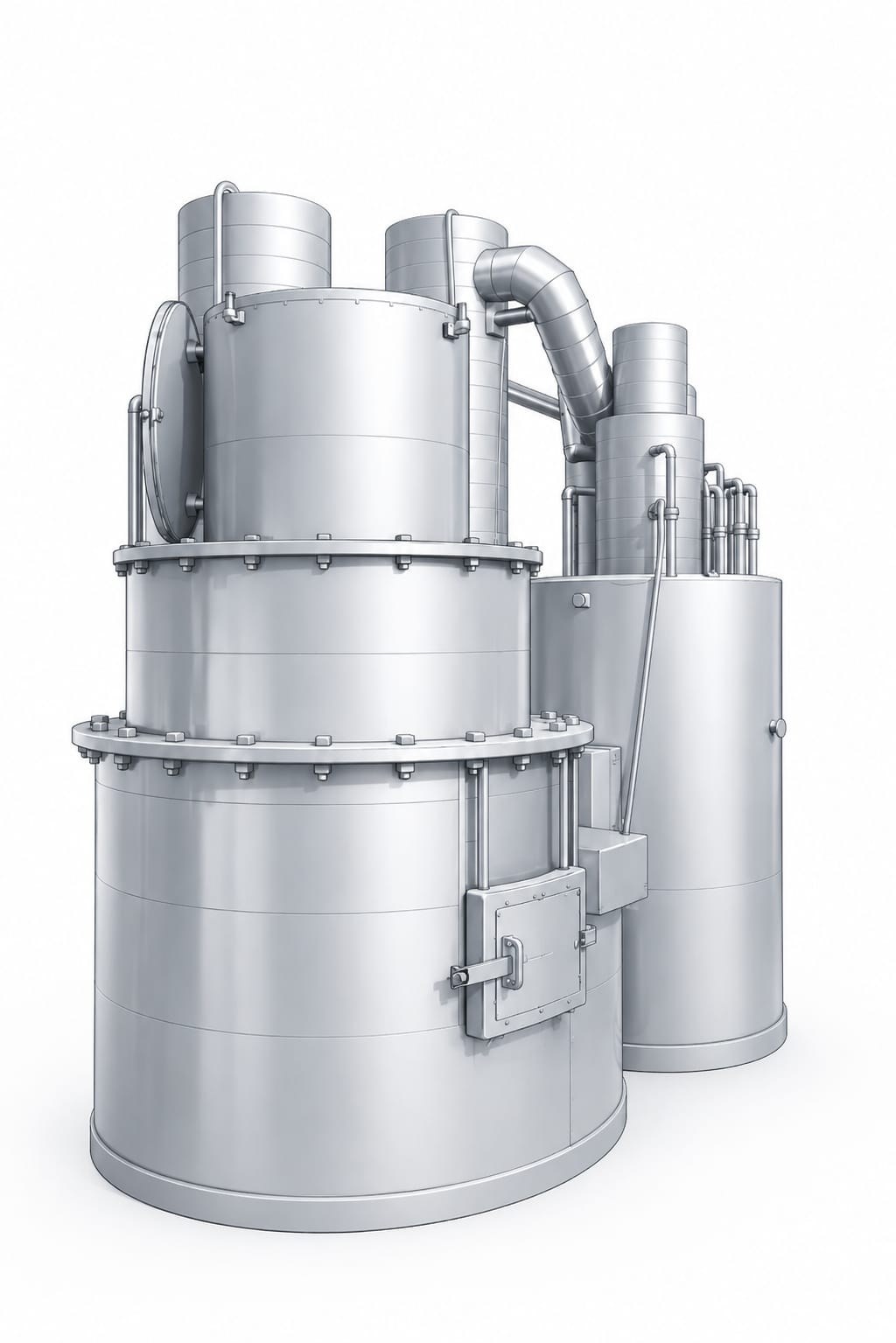
Catalytic breakdown
Under 400°C, our proprietary catalyst breaks complex hazardous molecules into syngas. Low temperature means low energy input and gentle treatment of the catalyst.
Stage 1 catalytically breaks down hazardous waste at under 400°C. Stage 2 destroys the residual stream at over 2,000°C. A PSA cleanup delivers 99.999% pure hydrogen at about 200 kg/hr per 12 MW module (1,700 t/yr). The whole architecture emits under 5% CO₂ — five times cleaner than conventional incineration.
Most waste-to-energy systems are single-stage incinerators. Ours is split into two thermal chambers, each optimised for a different chemistry job. That separation is what unlocks both the CO₂ reduction and the hydrogen yield.
Under 400°C, our proprietary catalyst breaks complex hazardous molecules into syngas. Low temperature means low energy input and gentle treatment of the catalyst.
Over 2,000°C destroys the most persistent compounds — PFAS, dioxins, chlorinated organics — that conventional incinerators cannot fully break down.
Standard PSA module isolates hydrogen from the gas stream and delivers it at pipeline grade — ready for industrial off-take, mobility, or grid injection.
The conventional waste-to-energy industry burns at 1,100–1,300°C and emits 25–30% CO₂. PFAS slips through. Hydrogen yield is negligible. Our two-stage architecture is what changes the economics.
Independent academic validation of our prototype operation, lead by Olga Pihl, PhD.
MoU signed May 2026. Host site for our first commercial unit, including SO₂ integration into KKT's existing process.
Estonian deep-tech company building in Tallinn. Patent family preparation underway across priority jurisdictions.
Full mass and energy balance, reactor specifications, and validation report available on request to qualified investors and partners.